

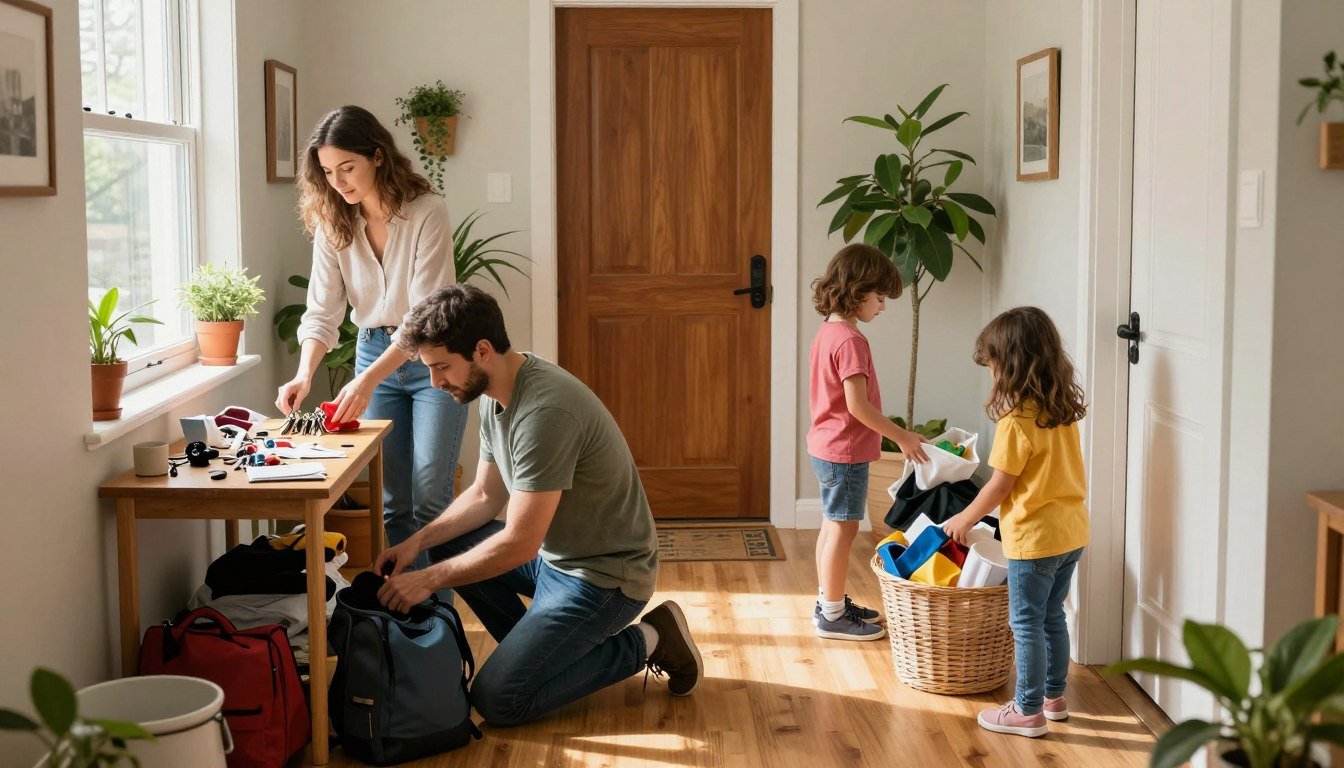
A simpler life can start with one deliberate choice rather than a weekend spent emptying every cupboard. Minimalist living tips can help when your home feels crowded, your days feel rushed, or clutter keeps drawing your attention.
You can begin with one manageable change and decide what you want more room for. That might mean more time, calmer mornings, or extra space for family activities. The goal is a life that fits you, not a picture-perfect home that looks untouched.
You do not need to make every choice at once. A small change can show what helps, what does not, and what you want to keep doing.
Before changing anything, name one part of daily life you would like to feel less crowded.
What Is a Minimalist Lifestyle in Practice?
A minimalist lifestyle is a set of choices that keeps what serves your life and reduces what repeatedly gets in its way. There is no required number of belongings. The right amount depends on what you use, what matters to you, and the room you have.
Intentional living means making deliberate choices about possessions, commitments, spending, and attention according to personal priorities. People can apply it to one area or several, and their choices can change as life changes.
What Does a Minimalist Person Do Differently?
A minimalist person makes decisions based on use and meaning, not on a certain look. For example, someone might keep a clear entryway, follow a repeatable dinner plan, or protect one open evening each week.
Those minimalist living examples can make everyday tasks easier without making a home feel bare. A person might keep extra chairs for guests but let an unused corner stay empty.
Choose what earns a place in your life, not what fits someone else’s count of things.
Deliberate buying is one common trait: a person considers whether an item fits a real need before bringing it home. Another is comfort with some unused space, which can make a room easier to use.
People also make different tradeoffs. One person may value a clear kitchen, while another gives more attention to fewer commitments or a calmer spending plan.
Minimalism does not depend on a uniform style, home size, or family setup. Use the version that supports your actual priorities rather than copying someone else’s rules.
What Benefits Can Minimalist Living Bring?
Minimalist living may support well-being, but research does not make it a guaranteed route to feeling better. Possible benefits include less time spent looking for things or managing tasks, though results differ by person.
A less crowded room may make a daily chore easier to finish. A lighter calendar may leave more freedom for rest, friends, or work that matters to you.
A 2024 survey of 537 participants, whose mean age was 43, found positive links between minimalism, subjective well-being, and four parts of psychological well-being.
The study found no significant link with psychological need satisfaction. This matters because one positive result does not mean every part of well-being improves.
A 2023 study of millennials found a positive relationship between minimalism and well-being. Fulfillment helped explain that relationship, but the result does not prove minimalism caused better well-being.
These studies describe group patterns, not a promise about one person’s mind or life. A change that saves time for one household may add work for another.
Notice practical effects that you can see, such as fewer lost keys or an easier path through a room. Treat any benefit as something to notice in your own life, not a result you owe anyone.
How Can Beginners Start Decluttering Without Burnout?
If the whole house feels like too much, begin with one drawer, shelf, or other contained area. A small start gives you room to make careful choices without taking on every task at once.
Set a stopping point before you begin. A clear limit, such as one drawer or a few minutes, keeps the process from taking over your day.
A Beginner Checklist for Decluttering
Use this checklist for a simple first session. Each step gives the items a clear next place instead of leaving a half-sorted pile.
- Choose one small area, such as a single drawer or shelf.
- Set a stopping point, like one surface or a 10-minute timer.
- Sort what is useful from what is broken, unused, or no longer needed.
- Decide where each item goes: keep it, give it away, recycle it, or discard it safely.
Two Timed Challenges to Try
A 10-minute decluttering challenge uses 10 minutes per day for 30 days. It suits a gentle pace because each session has a short, clear limit.
The 30-Day Minimalism Game starts with removing one item on day one. The daily total rises by one item each following day, so the task grows harder as the month goes on.
The game may not suit limited energy or a high volume of belongings. You can shorten the run, remove fewer items, or skip days when needed.
Some items need more thought than a quick timer allows. Pause when a choice affects safety, access, care, or a record you may need later.
Stop a session while you still have energy to make careful decisions.
How Can You Declutter a Home One Space at a Time?
A room-by-room sweep works best when you decide what belongs in each area before trying to organize it. Start with function: choose what the space needs to support, then sort its clutter.
Decide what stays before buying storage containers. A bin can hide extra possessions, but it cannot make an unused item useful.
Use the table to make a first decision in common catch-all spots. Keep daily essentials close, and return things that belong elsewhere.
| Space | Common catch-all | First decision | Useful exception |
|---|---|---|---|
| Kitchen counter | Duplicate tools and mail | Keep one working tool near its use | Keep a second tool if two people use it at once |
| Entryway | Keys, bags, and loose shoes | Keep daily items in one set spot | Leave seasonal gear available during its season |
| Bedroom nightstand | Books, chargers, and small items | Keep what supports bedtime or morning | Keep needed medicine within safe reach |
| Living-room surface | Remote controls and things from other rooms | Return items that belong elsewhere | Keep a book or game used by the household |
Uncertain duplicate items can go in a closed box kept out of sight for 30 days. If nothing is needed or missed, donate those items.
Use that box only for uncertain duplicates. Do not put documents or things needed for work, care, or safety inside it.
Check each space after you use it for a few days. If an item has no clear home, decide whether it belongs there or needs another place.
Keep the tools you use often within reach of the place where you use them.
How Do You Stop New Clutter From Coming Back?
A purchase boundary works best when it gives you time to ask what the item will add and what it will require. Pause before checkout to consider its use, care, and cost.
For a nonessential purchase, wait 48 hours before deciding. That pause gives an immediate want time to settle before money leaves your account.
These three boundaries can make shopping more deliberate without banning useful things. Choose the ones that match your needs and habits.
- Wait 48 hours before buying a nonessential item.
- Keep a wish list and review it instead of checking out right away.
- Use one-in, one-out when a new item replaces a similar one.
One-in, one-out can help with items such as mugs or sweaters when a new one replaces an old one. It does not fit consumables or a genuine change in need.
Before adding an item, consider its upkeep. Some things also need storage space, repair, supplies, or recurring payments.
A small declutter-as-you-go habit can help when one area starts to feel full. Clear a few things from that space before its usual use becomes difficult.
That habit can be brief: return misplaced items, recycle old packaging, or remove things that no longer serve the space. Choose a time that fits your routine.
A written wish list makes repeated wants visible before they become another purchase.
How Can Minimalist Living Tips Help You Build a Wardrobe?
A useful capsule wardrobe is measured by outfits that work for your real week, not by how few pieces you can own. Wearable outfits matter more than an impressive count.
Check complete outfits, shoes, and laundry before deciding you need more pieces. A wardrobe can feel short on options when one pair of shoes is unavailable or laundry is delayed.
Read Capsule-Wardrobe Numbers as Context, Not a Target
A 2026 analysis of 6,726 Cladwell user capsules found a median size of 30 clothing and shoe pieces. The count describes app users, not an ideal wardrobe size.
The spread was broad: 19% had 1-15 pieces, 12% had 16-23, and 26% had 24-33. Another 6% had 34-40, 11% had 41-60, and 26% had 61 or more.
The capsule-size figures describe app users, not how often they wore each piece. Use them as context, not as a standard for your own closet.
Before adding anything, lay out outfits for a typical week. Include shoes and check whether laundry access lets you wear the pieces often enough.
Try a Defined Capsule Before Making a Bigger Change
Project 333 is a challenge to dress with 33 items or fewer for three months. It can be a time-limited test of how a smaller set works in daily life.
A 10-item capsule uses 10 pieces for 10 days or styles them into 10 outfits. Both options are experiments, not required standards for a minimalist wardrobe.
Try a shorter test if three months feels too restrictive. Keep clothing needed for work, weather, health, or special activities outside the trial when necessary.
Build Outfits From Staples and Simple Formulas
Simple outfit formulas can make a smaller collection easier to use. The table offers three different starting points, each with its own structure.
| Approach | Structure | Useful starting point |
|---|---|---|
| 10-item capsule | 10 pieces for 10 days or 10 outfits | Test one short season or work period |
| 5-4-3-2-1 formula | 5 shirts, 4 bottoms, 3 dresses or suits, 2 shoes, 1 jacket | Plan pieces that work together |
| 57-piece checklist | 57 clothing, shoe, and accessory pieces | Review a broader closet without a strict edit |
Six staple clothing types can help you picture mix-and-match outfits: a white button-down shirt, straight-leg jeans, a white T-shirt, a black dress, a crewneck sweater, and black trousers.
Those pieces are examples, not a universal shopping list. Your own staples may include a uniform, work gear, cultural clothing, or clothes suited to a mobility aid.
Keep weather, work requirements, fit changes, and laundry access in view when deciding which formula to use.
How Can You Simplify Daily Routines, Meals, and Skin Care?
A repeatable routine can remove a daily decision without making every day identical. Simple patterns leave room for changes in appetite, schedules, and personal needs.
Repeat a few low-effort choices, then vary them when life calls for it. This can ease routine decisions without turning every day into the same plan.
Make the Weekly Meal Decision Easier
Repeating breakfast or lunch can reduce the number of decisions you make each day. You might use oatmeal on weekdays or pack the same basic lunch several times.
For dinner, rotate a few meals that fit your week, such as soup, tacos, pasta, or a sheet-pan meal. A short list can make planning simpler without fixing every meal.
Allergies, medical needs, preferences, and household schedules may call for separate meals or more variety. A routine should make food easier, not block a person’s needs.
What Does Minimalist Skincare Include?
Minimalist skincare can mean a cleanser, moisturizer, and sunscreen chosen for your skin’s needs. No single product works for all skin types or concerns.
The American Academy of Dermatology recommends cleansing, moisturizing, and protecting skin as basic care. Wash your face no more than twice a day and after sweating.
Choose broad-spectrum sunscreen with SPF 30 or higher. Reapply it every two hours, or after swimming or sweating.
Skin may respond differently to products, even when a routine has only a few steps. Keep product directions in mind, especially for sunscreen and treatments.
If a skin product causes irritation, stop using it and ask a dermatologist for advice suited to your skin.
How Can Minimalism Change Spending and Textile Waste?
A minimalist budget is a way to direct money toward priorities, not a rule against spending. Choose the purpose for your money before deciding where to reduce costs.
Give money clear jobs, while leaving room for needs that change. A plan can support essentials and chosen experiences without treating every want as waste.
Give Your Budget a Clear Purpose
You can assign money to essentials, savings, and experiences you value. The amounts depend on your income, needs, and current goals.
A 52-week savings challenge is one optional structure. It can build more than $1,000 in 45 weeks without any weekly contribution over $45.
Treat the challenge as an option, not financial advice. It may not suit every budget, especially when bills or income change from week to week.
Understand the Wider Problem of Textile Waste
Household choices sit within a much larger textile system. U.S. textile waste increased by over 50 percent between 2000 and 2018.
Most used textiles in the United States are discarded into municipal solid waste streams. Fast fashion, limited collection and sorting, and early-stage recycling technology all add to the problem.
The table shows how those factors affect what happens to clothing and other textiles. Each one points to a different part of the system.
| Contributing factor | Current condition | Why it matters |
|---|---|---|
| Fast fashion | Low-cost clothing can encourage frequent turnover | More discarded textiles can enter waste streams |
| Textile collection and sorting | Systems are limited and decentralized | Used textiles may not reach reuse or recycling routes |
| Recycling technology | Many recycling technologies remain early-stage | Recycling cannot yet handle every discarded textile |
Reusing clothing or buying with care can be one household choice. It does not solve a system-wide problem or replace better collection and recycling systems.
Use waste figures to inform your choices without treating one person’s closet as the whole textile system.
How Do You Clear Digital Clutter and Protect Your Time?
A crowded inbox and a crowded calendar create different problems, so reduce each with a separate decision. Digital clutter often comes from messages, apps, alerts, and accounts competing for attention.
Reduce incoming noise before deleting files you may need. Records, photos, and work files may need to stay, even when your phone feels crowded.
Use this four-part reset for the parts of your phone and inbox that interrupt your day. Choose one category at a time.
- Unsubscribe from email lists you no longer want.
- Remove apps you no longer use.
- Mute notifications that do not help you act or stay safe.
- Unfollow accounts that consistently drain your attention.
Deletion is not the right choice for every file, photo, or record. Back up and sort material you may need before removing it from a device.
A cleaner inbox can help, but calendar clutter can take up time in a different way. Review recurring commitments as well as one-off events.
Decline tasks that do not fit your current priorities when you have the choice. A recurring meeting or volunteer role can take more time than a single event.
Leave room for plans to change, too. A calendar filled to its edges can make a late task or a needed rest harder to fit.
Put one phone-free block on the calendar and protect it like any other appointment.
How Can You Make More Room for Experiences?
An evening with a friend or a walk close to home can matter as much as a major trip. Experiences can be simple, and they do not need to be costly or elaborate.
Make room for the activities and people that matter to you. A regular walk, shared meal, or quiet afternoon can feel more useful than adding another item to your schedule.
Travel can also be an experiment in carrying less. For a four-day trip, you might pack for two days if you plan to wash clothes or rewear outfits.
That approach works best when the trip allows repeat outfits and easy laundry. It may not fit formal events, limited laundry access, or weather changes.
Consider the plans before choosing what to pack. A work trip, a family visit, and a camping weekend can call for different things.
Making more room for an experience does not require an empty calendar. It can mean choosing one activity and leaving enough time to enjoy it.
After a trip, note which items you never used before packing for the next one.
How Can Minimalist Living Work for a Family?
A family can simplify together without asking every person to want the same home. Shared choices work best when personal belongings and common spaces get different rules.
Agree on shared areas rather than setting one standard for everyone’s things. A household can make daily life easier without asking each person to give up what matters to them.
These four steps can help a household start with needs, not a single person’s idea of a tidy home.
- Separate personal belongings from shared items.
- Agree on one shared space to maintain together.
- Ask each household member what makes daily life harder.
- Revisit decisions as needs and routines change.
One family of four took about nine months to declutter its possessions. That experience shows a gradual process, not a timetable other households must follow.
Children’s needs change as they grow, so clothing, toys, and school items may need regular updates. Accessibility and caregiving needs can also affect what a household keeps close.
Some hobbies need equipment that takes up space, such as sports gear or musical instruments. The item count alone cannot show whether that equipment supports a valued activity.
Ask what would make shared life easier, then make one agreement that everyone can understand. It can be reviewed when family routines shift.
A shared rule should protect one common area without imposing the same personal standard on everyone.
How Do You Keep Minimalism Flexible and Sustainable?
A useful minimalist practice can change when your health, work, household, or interests change. Flexibility matters because a rule that once helped may later create extra work.
Keep belongings that serve a clear purpose or hold real meaning for you. Collections, gifts, backups, and sentimental objects can all fit a minimalist life.
Deliberate keeping differs from holding everything out of guilt or fear. A collection you enjoy is different from an item you keep only because someone gave it to you.
Review one rule that feels restrictive. Ask whether it saves time, money, or space without creating a new burden elsewhere.
Keeping a useful backup may be safer than donating it. Replacing an item later can cost more or create hardship when access, money, or time is limited.
Keep the practices that help your life, and change the ones that turn into another source of pressure.
Meaning can shift over time. A keepsake may matter less after a move, while a new interest may give another object a clear role.
Record what improved and what felt unnecessarily restrictive, then adjust the rule.
Conclusion
Minimalism is most useful when it gives more room to live according to your own priorities. A simpler life is defined by what matters to you, not by a strict number of belongings.
Choose one action that could return useful space, attention, or time. Try it, then decide later whether it helped your daily life.
Choose one small change today and set a time to try it before the week fills up.






Leave a Reply